The parallel consciousness of self and surroundings... is the key to transforming mentalities and reshaping societies.” -

Edouard Glisant


Friday, 14 October 2011

Once there were two rivers

In 1949 Willem Bezuidenhout (son of Frederick Bezuidenhout) sold the land that is now Bezuidenhout Park on condition that it be used as a park for the benefit of the community; that the family home be maintained by the City Council; and that the family graveyard remain on the property.

The Bezuidenhout farmhouse is still there. Now a national monument , it is used by the Rotary Club for meetings and office space. The family graveyard, although vandalized in recent years, is still there too.
The house was built in three portions over a period of time. The main portion was the centre of the house. It was built of mud and brick, with a thatched roof, in 1863 and consisted of a front room, two small bedrooms on either side, a bathroom and a kitchen.
In around 1880 a new kitchen was added at the back of the farmhouse and the existing kitchen was converted into a pantry.
More substantial additions were made to the farmstead in 1887, at about the time that the Bezuidenhouts were selling off the land for the development of Doornfontein and New Doornfontein. These included two bedrooms, a bathroom and typically Victorian ornamental features such as a bay window and barge-boarded gables. The changes have given the house a Victorian character.

City Parks horticulturalist, Alan Buff, who lived in the house from 1981-1986, met members of the Bezuidenhout family when they gathered for a family reunion while he was living there. The oldest descendant at the time was well into her nineties. She told Buff that she had memories as a ten year old child, of being caught up in the activities taking place in the old kitchen, where fruit and vegetables were cooked and bottled; dairy products processed and packaged; and candles produced for sale to members of the Chinese community who had a market located on the site where Darras Centre is now situated.

There was a fireplace in the back room of the house, she said, and the family used to sit there to do the book work relating to the administration of the farm.

In the front room on the right hand side of the property, a mural of Cape Town was painted on one entire wall by an Italian artist who was commissioned by the Bezuidenhout family. The artist apparently came to South Africa to make his fortune but his plans were interrupted when the Anglo-Boer War broke out. The money he was paid by the Bezuidenhout family helped him to get back home.
Originally the Bezuidenhouts planted oak trees and grew a variety of fruit trees, almond and walnut trees. The family orchards extended through the suburb that is now Cyrildene, right up to Gillooly’s Farm. Streets in Cyrildene are named after members of the Bezuidenhout family.

Bezuidenhout Park still contains oak trees planted by a member of the Bezuidenhout family, who brought seeds from Cape Town in the 1860s. Alan Buff confirmed this by counting the annual rings of an oak tree that came down about ten years ago. There were stables where the Oak trees are in the park today.


Water came from a number of sources. There was a well that was in the vicinity of what is today the car park and a natural wetland which the animals drank from, in the place where the sports fields now are. Two rivers dissected the property. One came down with stormwater from Doornfontein. Originally it flowed from Brickfields in Newtown, through Joubert Park, to the dam which is now the Ellis Park Stadium, and on through Bertrams to Bez Valley. It ran through the bottom of the property to what is now Bruma Lake. The other river still exists today. It runs through the Observatory golf course.

After the property was sold to the City of Johannesburg, the municipality decided to build a storm water system and then to develop the sports fields. Once the canal had been built and the water diverted, the wetlands started to dry up. The land was then considered suitable to be used for recreational purposes.
With the British occupation during the Anglo-Boer War, the small cottage on the left hand side of the homestead was taken over.
The Indian horse brigade, which consisted of some 4, 000 horses, maintained by 7,000 non-combatant Indian forces, camped out in the area of Bezuidenhout Park that is now the caravan park. The monument to these Indian soldiers is on Observatory Ridge. Originally a cemetery was established especially for them in Observatory Park, just behind the electricity service station. Only four soldiers were buried there according to Buff. In the 1960s their bodies were exhumed and moved to the Braamfontein cemetery.

Buff was told that the section of the park that is more or less where the Siyakhana Food Garden is now situated, was where a Concentration Camp for Black internees was set up during the Anglo-Boer War.
(*Blog on Siyakhna below)

Thursday, 13 October 2011

Back to Eden... The Siyakhana Food Gardens

The Siyakhana Food Gardens were established in Bezuidenhout Park in 2005 in a partnership between Wits University and 16 Early Childhood Development and Home-Based Care NGOs.
http://siyakhana-org.win24.wadns.net/WhatWeDo/FoodGarden.aspx


Mandla Tshabalala is the manager. A member of the Seventh Day Adventist Reformed Church and resident caretaker of the church property in 8th Avenue, Bez Valley, Mandla began as a volunteer when the garden was still a dump site.

His knowledge and his love of gardening come from observing his gardener grandmother as a child; from his training at a permaculture school in the Free State and an eco-village in Germany; from the Bible; and from teachings contained in the book  Back to Eden, claiming that everything that humankind needs for nutrition and healing is provided for naturally.

Quoting from Back to Eden and from the Bible, Mandla talks of a wide variety of herbs that can be used for the healing of boils; cancer, heart conditions, diabetes, stomach complaints, syphilis, blood ailments, sinusitis, and many other illnesses. Herbs grown in the Siyakhana Food Garden  include White Clover, Yarrow, Comfrey, Borage, Feverfew, St. John’s Wort, Sage, Calendula, Roux, Peppermint, Fennel, Lemon grass, Oregano, Plantain, Sage and Marjoram.

The first trees were planted by Trees and Foods for Africa activists in 2005. Today the garden contains an orchard full of fruit bearing apricot, peach, pecan nut, plum, lemon, olive and apple trees, and a food garden that produces a wide variety of vegetables including beans, cabbages, lettuce, tomatoes and spinach. Produce is given to NGO partners in the inner city of Johannesburg.
Dried herbs and a variety of vegetable salts and creams are also on sale to visitors.
Siyakhana has a number of purposes. It is a research site for university students; a permaculture training centre; a site for pionering eco-buildings; and the propagation of plants is important. “Seeds are replanted… Some will be sold to food gardens or NGOs… The idea is to keep the cycle going so that skills are not lost and so we can reach out to others because we now have an abundance of herbs and trees and shrubs,” Mandla says.

There are many visitors to the garden. They come to observe, to learn, to be inspired, and to consult Mandla not only about permaculture gardening but also about healing remedies.  A close neighbour who visits Mandla on a regular basis about growing vegetables and healing herbs, is the man who manages the cleaning of the Jukskei in the Park (see earlier blog, The River Runs Thru).

“Community members consult me about their ailments. People learned about the use of herbs and they came here to get some. I have stopped it because it upset a lot of other things I have do do in the garden, but I still advise people in my personal capacity.”

Tuesday, 27 September 2011

Fear and the fearless foreigners

A team of traveling ‘eco-mystics’ cycled from Oliver Tambo airport to Rhodes Park on bicycles made from the branches of trees and an assortment of natural materials, which they brought with them on the 'plane from France.  Soon after arriving at the park they set up sleeping arrangements using nets and rope wound round trees beside the lake. 

The group consisting of Mickael (Mika), 12-year old Axel and two women, Laurence (Lo) and Eileen, are from different eco-communities in the south of France, where they live in houses built from bamboo, mud or ancient stone, and grow their own food.


They met at a festival of ‘New Energy’ and three weeks later made the journey together, inspired by a dream in which Mika was told to take a trip to South Africa in September.

Artists, writers, storytellers, healers, they live very simply, close to the Earth, and invite others to travel with them, especially people who are struggling or ill.

After a series of revelations (‘enigma’) over a period of a year, Mika, whose travels include a 13 month journey by bicycle from France to Australia, believes that life on Earth as it exists today will come to an end before long. Indicating with a movement of his hands he says, “The world will turn upside down and the oceans will flood the continents…”

Tony Lopes taught the group how to make a wood gas stove and a local gardener/security guard/Jack of all trades named Albert befriended them and took them to the backroom of the Kensington house where he lives when they were harassed by the police. Albert has no electricity in his room and cooks with paraffin.  He made them a pot of pap and asked them if they wanted him to heat some water for a bath but apparently they said, “We will wait for the rain.”

I was struck by their practicality, their defiance of the conventional, and their absolute trust that they would end up where they were supposed to be. 

We have become accustomed to living in fear in South Africa so this group of people who had no fear brought new hope and energy to the park and to the diverse group of people from the community that felt drawn to them.

They left as unexpectedly as they arrived. Albert gave Tony a note from Mika. It read: “We are headed in the direction of Limpopo.”

Thursday, 22 September 2011

The river runs thru

The Jukskei River is said to have got its name from the chance find on its banks of a broken yoke key discarded by Captain Cornwallis, an early traveller and hunter in the area. The Jukskei, which has also been a major actor in the unfolding drama of the  search for gold, is Johannesburg’s largest north-flowing “river”.

The upper reaches of the river were canalised at a time when storm water runoff was seen as an irritation rather than an asset. Although local problems were addressed by the canalisation, the result has been to transfer the problems further downstream.  The momentum and force of a canalised stream together with the increased runoff from the city has created treacherous floodwaters and severe soil erosion.

The ecology of the valley that the river flows through has been radically undermined by the impact of urban development. “Deeply eroded, unstable banks, created by high volumes of high velocity storm water runoff, characterize much of the course downstream.” (Johannesburg City Council,1986. The Mervyn King Ridge Trail).
 
Historical perceptions of water as a means of getting rid of waste play themselves out in the day-to-day experience of Edmond Thokozani Sibisi (Thokozani), who claims descendence from the famous chief, Bambatha. His job is to monitor and clear the waste in a section of the Jukskei on the east side of Bezuidenhout Park (historically a section of Doornfontein farmland).
Chief Bambatha (at the back)
Thokozani comes from Mahlabathini in KwaZulu-Natal (KZN). His wife and children still live there. A migrant worker, he returns home once a year for one month. This year, instead of taking all his leave in December as he usuallly does, he divided the 30 days into two, two-week stretches, and has recently returned from a trip home to perform a traditional ritual for his ancestor who was killed during the ‘Bambatha Rebellion’ (1906). Between 3,000 and 4,000 Zulus were killed during the revolt. One of my ancestors, by tradition, was called up to “quell” it. http://en.wikipedia.org/wiki/Bambatha_Rebellion
In 1976, Thokozani came to Johannesburg to look for work for the first time. He was employed by a removal company and then as a security guard before giving up hope of sustaining himself in Jo'burg.

After a series of dreams filled with symbols and myths and the whispered utterances of ancestors, and finally a dream involving a struggle underwater with a gigantic serpent, he responded to a calling to become a sangoma and went to Kwambulinga in KZN for training. But shortly after the training began, Thokozani’s trainer demanded R 22,000. He said, “I can’t do that. I am still suffering.” The trainer said, “If you haven’t got money to pay, it is better if you go and find work and if you find money, come back to continue.”

So he came back to Johannesburg and as it turned out, he found the people in his dream repairing a fence in Bezuidenhout Park and they offered him a job. A man called Ian Dirk was busy cleaning the river and he said, “Come with me. I have got the money to pay you.”

Initially he was taught how to restore the workshop that contains the tools and given a caravan to live in. This was in 2004. “I was watching the place, stopping the people who came to steal. My God helped me to stop those people who came to steal”, he says. That was in 2005.
“Then I was asked to help to reprieve this thing…It is a water litter trap”, he says. A “two hole system” has been constructed to “trap” everything flowing down the Jukskei, including a car, aborted foetuses and even a dead man and a dead baby: “It was a man of age between 38-45…I was crying because it was the first time to see a dead man here…Then there was one small baby. It was a baby that was born but they take out all those eyes… It’s the mother’s people, they do this thing,” he says.
Thokozani lives alone in a converted container in small section of Bezuidenhout Park near to Bruma Lake,  protected by a dog called Minibus. He grows all his own vegetables but there is theft. “It is the community... because there is no fence, they come and take everything without asking….”
 
He has two assistants to help him to clear the waste blocked by the mechanical trap. “We’ve got forks and spades and we load into that big skip, and when it’s full I call the ‘West Giant’ to come and get it".

The daily challenges take their toll. “We find trees and building construction rubbish, and some people make their shit in there. I don’t know if there is no toilet where they stay… Please the people must be stopped to do this. They must keep clean the Bez Valley. Especially that abortion… Tell those people to stop making abortion and throwing those dead babies in the water…Please!”

Sunday, 18 September 2011

Tony Lopes

Tony Lopes lived in 10th Street Bez Valley before moving into a townhouse in Kensington with a small garden which he has transformed into a laboratory of miracles and wonders.
  
Gardener, inventor, conservationist, modern day alchemist and mystic, Tony cooks with solar energy or methane gas produced in an assortment of discarded coffee and paint tins; grows his own vegetables; runs his car on rancid cooking oil, is experimenting with an anaerobic digester; heats his water with a solar geyser made from coke bottles, and recycles just about everything.
An electrical engineer by training, Tony began to change his way of life after reading Einstein; Masanobu Fukuoka, the Japanese farmer/philosopher and author of ‘The One-Straw Revolution’; author and director of ‘Grow Bio intensive Mini-Farming programme for Ecology Action’, John Jeavons; and The Ringing Cedars’ books, which were first published in Russian and then translated into 20 other languages.  The books are a documentary account of a man called Vladimir Megré’s encounters with an extraordinary, almost mythical character known as Anastasia, over a period of 10 years. People from all over the world who have read the books have radically rearranged their lives.

Tony spends hours doing Internet research and then tries out his new inventions, experimenting and learning on his feet.  Each new initiative involves research, networking, and tracking down components for the lowest possible price. It’s hard work. For instance, to collect cow manure, he travelled into a deep rural area where one of the wheels of his vehicle was damaged when it got stuck in the mud.  “Everything has a story to it. Nothing is easy,” he says.

In 2009, Tony built solar cooker using a Masonite wood panel, a wooden frame, galvanized sheeting, and cardboard for insulation.  He uses it to cook rice, potatoes, beans, millet, sorghum, mielie-meal and his own sour-dough bread. It doesn’t work when there is no sun, so he has constructed a wood/gas stove made out of a discarded ‘Ricoffy’ and paint tins, which produces sufficient gas (hydrogen, methane, and carbon monoxide) to cook food. Tony’s experiments with a bio-digester involved purchasing a 1,000 liter water tank for R 500 through Junk Mail. It is filled with water and fresh cow manure, which contains bacteria that creates methane gas, which is used for cooking.  
His solar geyser was modeled on the work of a retired Brazilian mechanic, Jose Alano, using used coke bottles and long life milk/fruit juice tetra pak cartons. It has cut his municipal electricity costs down to R 160 per month.
Discarded vegetable oil, collected from fish and chips shops or catering businesses and more recently from the St Giles Association for the disabled in Kensington, is used to power Tony’s van, according to principles developed by Dr. Rudolf Diesel in 1895.  This involves a two-tank system which allows Tony to start up his vehicle using diesel and then when the engine is hot, to switch over to vegetable oil. “The conversion wasn’t easy,” he says, “So there were school fees…”
In his small garden, Tony grows blueberries, youngberries, sweet peas, cabbages, broad beans, kale, strawberries, parsley, rosemary, tomatoes, and comfrey, in between persimmon, olive, prune,  avocado, peach, fig, apricot, guava, and almond  trees. He also cultivates mushrooms and a variety of medicinal plants.

“I like the science, I like to do the research because of my background as an engineer, but I need to get out into my garden because that is where the divine engineering happens.”

Wednesday, 14 September 2011

Children

Debbie founded the Little Saints Pre-School on the Kensington/Bez Valley border in 2001. The school is run in partnership with the Bethany shelter for abused women in Bertrams. Madina started the Bismillah Pre-School in Bez Valley in 2003.   Both schools adapt themselves to the realities of the neighbourhood.
The schools take children from birth to six years of age. There are 88 children at the Little Saints Pre-School and 90 at Bismillah. Little Saints opens its doors at 07.00 in the morning and closes at 17.30.  Bismillah is open from 6.00 a.m. to 6.00 p.m. Afterschool care is offered to primary school children.

Most Bismillah parents are single mothers, generally domestic workers or street traders. More and more Little Saints parents, which is less than a kilometer away, are single fathers or from families where fathers are doing more of the parenting than mothers. 
Children at the schools live in Hillbrow, Yeoville, Jeppestown, Bez Valley, Bertrams, Malvern, Kensington. The majority of children at the Bismillah school live in Bez Valley.
Communication is a daily challenge. Many of the children do not speak English or any other South African language, and nor do their parents.  The children are from South Africa, Ethiopia, Sudan, Uganda, Nigeria, Zimbabwe, Angola, Mozambique, Zambia, DRC, Kenya, Malawi, and India. They come and go, generally because parents lose their jobs or get evicted from houses and are forced to relocate.

“We live in an environment where people struggle to survive. Either there is a single mother who needs to work or we have a lot of single fathers in this school because the mothers are into drugs or alcohol so they are not involved in the child’s life... So you need to be able to educate the child to take care of themselves …If you can empower the child to feel confident enough to speak up if they are not comfortable with what is going on, then you have given them a skill for life,” Debbie says.
She stresses that a parent’s occupation has nothing to do with good parenting. The father of a child who is no longer at the school was clearly a drug dealer, she tells me. He attended all the talks and meetings at the school and implemented what he learned, with very positive consequences for his child.

Single mothers work very long hours and are too exhausted to be good mothers. “There is a lot of neglect,” Madina says. “The child will come dirty, empty bag, crying and not happy at school. There is no love, no attention.  Most are living in backrooms and rooms in houses, sharing rooms. Sometimes there are eight families in one house…  I have one child right now where the mother is going under to depression because of her condition. Her rent is high. She is selling on the streets in town. She comes from Congo.  I am looking at sponsoring the child because this is someone you can see is not lying. This is a reality…She comes in tears, she can’t pay.”
Pre-schools in the area  support one another and share resources. “We speak to one another. Debbie donates extra toys and invites us to functions and courses. She does a lot for the area,” Madina says. 
School fees are not sufficient to cover the cost of food for the children and salaries.

“People must open their hearts. A lot of people are struggling… In the last two years things have got worse and worse. Most end up sending their children to the villages because they can’t afford to pay,” Madina says.
If you would like to sponsor a child or make a donation to one of these pre-schools, please contact me and I will facilitate this (melodyemmett@gmail.com)

Sunday, 11 September 2011

Public principle and the individuation of conscience

The current owner of the Juno Street house in Kensington has built a garage blocking access to the abandoned mining cave which the Foster Gang set up as an emergency hide-away after a spate of violent robberies across the Reef in the early history of Johannesburg.
Foster was a charismatic psychopathic personality who, together with two members of his Gang, Johan Maxim, and Carl Mezar, wrought havoc in the small white community of his day. The drama was widespread and struck at the lives of a diverse group of South Africans.
The Gang was wanted for a string of robberies and the murder of three policemen and a passer-by, but nine other people also died. They included a Post Master who committed suicide after Foster and his Gang had robbed the Post office – he had been fiddling the petty cash and feared exposure; a doctor who was on his way to the Springs hospital to assist with an emergency operation; and the great gentleman-general and man of principle, Koos de la Rey, whose car was fired upon by the police, after his driver drove through a road block, believing it to be for his employer. **See note
Most tragic was the scene which played itself out outside the cave in Kensington in September 1914. The police had set up roadblocks around the city and surrounded the cave. A huge crowd had gathered.
The three men decided they would not be taken alive. Mezar was the first to die when Maxim killed him with a single shot. Maxim killed himself.
Foster had the extreme charismatic control of the psychopath, a fact which the Senior Police Officer understood well.  Foster asked for his wife, Peggy, the baby, and his parents and two sisters to be brought to the cave, promising that once he had seen them, he would hand himself over.
The Senior Officer refused to allow Foster’s wife and child to go inside the cave, protesting that he would kill them. Finally, under pressure from Inspector Edward Leach, he reluctantly agreed. 
For a while it seemed the idea would work, but after about an hour, Foster’s family stumbled out of the cave with the baby but without Peggy.
The crowd waited in silence and then a shot rang out, followed by two others.
Tormented by his culpability in the death of Peggy Foster, Inspector Edward Leach, committed suicide a few days later.
The Foster Gang saga is a drama of great classic theatre. It raises questions around sanity and insanity; the challenge of public responsibility; the dynamics of money, charisma and power; and relationships between men and women.
Perhaps this is one of the last occasions in which greater values played themselves out in a public event in the lives of ordinary people on the Witwatersrand. Perhaps it is a story of the end of public principle and the beginning of the individuation of conscience.

**They were on their way to meet the Boer rebels hoping to take advantage of the outbreak of World War One to liberate the old republics. De la Rey, personally, did not feel this wise, but in conscience, and out of loyalty, felt obliged to go and engage with his compatriots on the matter.

Friday, 9 September 2011

The Piano Tuner

Founder of the famous piano company, Steinway & Sons, Henry E. Steinway (1797-1871) began his career in the kitchen of his house in the town of Seeson in Germany. In 1836 he built a grand piano that became known as the “kitchen piano”. Today it is on display in the New York Metropolitan Museum of Art.

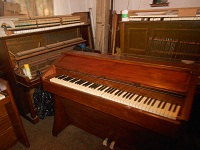
If it’s good enough for Steinway, it’s good enough for Brian Lawson, whose kitchen has been given over to the reconstruction, restoration, and repair of pianos. In fact virtually the entire 7th Avenue house has been devoted to pianos since Brian moved in, in 1999. 

He built a second story to make room for life without pianos but even then, there is only one chair in front of his computer. This is not a house for socialising or relaxing. It is a workshop.
 
After he finished school in Essex in the UK in the 1970s Brian, who says he grew up on the Beatles and prefers rock to classical music, went on the dole. His father was a trained classical pianist who eventually became a piano teacher in the local area. He persuaded Brian to register for a three year course in Piano Tuning, Repairs, Construction and Design at the London College of Furniture.

After working in the UK for a few years, Brian emigrated to South Africa in 1983 on contract with Kahn's Pianos. He went on to work for local piano retailer and then for 'The Music Shop' before setting up on his own in the Bez Valley house, which was previously owned by a fridge mechanic who used the front room - now crammed with pianos - as a night school for fridge mechanics.

“It is a question of adeptness and patience as well as excitement and passion,” Brian says, demonstrating the intricate process of cutting and sticking identical strips of leather eighty-eight times for the eighty-eight keys of an average piano.

Mice cause the most damage so five well-fed cats play an integral role in the life of the workshop.

Piano design has been dictated by fashion over the years, Brian says, pointing to an art deco piano.  “A modern family in the 1930s and 1940s needed a small piano”.
Pianos today are even more streamlined and mostly imported from 12 or more Chinese manufacturers.

A piano's value hinges on the quality of the sound it makes rather than its antiquity, Brian stresses, comparing a piano made in the 1890’s to a more recent Broadwood.

Generally pianos are tuned once a year but pianos in recording studios are tuned every day and concert pianos after rehearsals and again an hour or so before  a performance.

One of about 15 piano tuners in Gauteng, Brian leaves the more stressful work to others unless called upon to fill in when they are away, and avoids pressurised work if he can. "Why should I make somebody else's bad planning my emergency?" he says.

 www.lawsonic.co.za