“The parallel consciousness of self and surroundings... is the key to transforming mentalities and reshaping societies.” -

Edouard Glisant


Showing posts with label Community. Show all posts

Sunday, 18 September 2011

Tony Lopes

Tony Lopes lived in 10th Street Bez Valley before moving into a townhouse in Kensington with a small garden which he has transformed into a laboratory of miracles and wonders.
  
Gardener, inventor, conservationist, modern day alchemist and mystic, Tony cooks with solar energy or methane gas produced in an assortment of discarded coffee and paint tins; grows his own vegetables; runs his car on rancid cooking oil, is experimenting with an anaerobic digester; heats his water with a solar geyser made from coke bottles, and recycles just about everything.
An electrical engineer by training, Tony began to change his way of life after reading Einstein; Masanobu Fukuoka, the Japanese farmer/philosopher and author of ‘The One-Straw Revolution’; author and director of ‘Grow Bio intensive Mini-Farming programme for Ecology Action’, John Jeavons; and ‘The Ringing Cedars’ books, which were first published in Russian and then translated into 20 other languages.  The books are a documentary account of a man called Vladimir Megré’s encounters with an extraordinary, almost mythical character known as Anastasia, over a period of 10 years. People from all over the world who have read the books have radically rearranged their lives.

Tony spends hours doing Internet research and then tries out his new inventions, experimenting and learning on his feet.  Each new initiative involves research, networking, and tracking down components for the lowest possible price. It’s hard work. For instance, to collect cow manure, he travelled into a deep rural area where one of the wheels of his vehicle was damaged when it got stuck in the mud.  “Everything has a story to it. Nothing is easy,” he says.

In 2009, Tony built solar cooker using a Masonite wood panel, a wooden frame, galvanized sheeting, and cardboard for insulation.  He uses it to cook rice, potatoes, beans, millet, sorghum, mielie-meal and his own sour-dough bread. It doesn’t work when there is no sun, so he has constructed a wood/gas stove made out of a discarded ‘Ricoffy’ and paint tins, which produces sufficient gas (hydrogen, methane, and carbon monoxide) to cook food. Tony’s experiments with a bio-digester involved purchasing a 1,000 liter water tank for R 500 through Junk Mail. It is filled with water and fresh cow manure, which contains bacteria that creates methane gas, which is used for cooking.  
His solar geyser was modeled on the work of a retired Brazilian mechanic, Jose Alano, using used coke bottles and long life milk/fruit juice tetra pak cartons. It has cut his municipal electricity costs down to R 160 per month.
Discarded vegetable oil, collected from fish and chips shops or catering businesses and more recently from the St Giles Association for the disabled in Kensington, is used to power Tony’s van, according to principles developed by Dr. Rudolf Diesel in 1895.  This involves a two-tank system which allows Tony to start up his vehicle using diesel and then when the engine is hot, to switch over to vegetable oil. “The conversion wasn’t easy,” he says, “So there were school fees…”
In his small garden, Tony grows blueberries, youngberries, sweet peas, cabbages, broad beans, kale, strawberries, parsley, rosemary, tomatoes, and comfrey, in between persimmon, olive, prune,  avocado, peach, fig, apricot, guava, and almond  trees. He also cultivates mushrooms and a variety of medicinal plants.

“I like the science, I like to do the research because of my background as an engineer, but I need to get out into my garden because that is where the divine engineering happens.”

Wednesday, 14 September 2011

Children

Debbie founded the Little Saints Pre-School on the Kensington/Bez Valley border in 2001. The school is run in partnership with the Bethany shelter for abused women in Bertrams. Madina started the Bismillah Pre-School in Bez Valley in 2003.   Both schools adapt themselves to the realities of the neighbourhood.
The schools take children from birth to six years of age. There are 88 children at the Little Saints Pre-School and 90 at Bismillah. Little Saints opens its doors at 07.00 in the morning and closes at 17.30.  Bismillah is open from 6.00 a.m. to 6.00 p.m. Afterschool care is offered to primary school children.

Most Bismillah parents are single mothers, generally domestic workers or street traders. More and more Little Saints parents, which is less than a kilometer away, are single fathers or from families where fathers are doing more of the parenting than mothers. 
Children at the schools live in Hillbrow, Yeoville, Jeppestown, Bez Valley, Bertrams, Malvern, Kensington. The majority of children at the Bismillah school live in Bez Valley.
Communication is a daily challenge. Many of the children do not speak English or any other South African language, and nor do their parents.  The children are from South Africa, Ethiopia, Sudan, Uganda, Nigeria, Zimbabwe, Angola, Mozambique, Zambia, DRC, Kenya, Malawi, and India. They come and go, generally because parents lose their jobs or get evicted from houses and are forced to relocate.

“We live in an environment where people struggle to survive. Either there is a single mother who needs to work or we have a lot of single fathers in this school because the mothers are into drugs or alcohol so they are not involved in the child’s life... So you need to be able to educate the child to take care of themselves …If you can empower the child to feel confident enough to speak up if they are not comfortable with what is going on, then you have given them a skill for life,” Debbie says.
She stresses that a parent’s occupation has nothing to do with good parenting. The father of a child who is no longer at the school was clearly a drug dealer, she tells me. He attended all the talks and meetings at the school and implemented what he learned, with very positive consequences for his child.

Single mothers work very long hours and are too exhausted to be good mothers. “There is a lot of neglect,” Madina says. “The child will come dirty, empty bag, crying and not happy at school. There is no love, no attention.  Most are living in backrooms and rooms in houses, sharing rooms. Sometimes there are eight families in one house…  I have one child right now where the mother is going under to depression because of her condition. Her rent is high. She is selling on the streets in town. She comes from Congo.  I am looking at sponsoring the child because this is someone you can see is not lying. This is a reality…She comes in tears, she can’t pay.”
Pre-schools in the area  support one another and share resources. “We speak to one another. Debbie donates extra toys and invites us to functions and courses. She does a lot for the area,” Madina says. 
School fees are not sufficient to cover the cost of food for the children and salaries.

“People must open their hearts. A lot of people are struggling… In the last two years things have got worse and worse. Most end up sending their children to the villages because they can’t afford to pay,” Madina says.
If you would like to sponsor a child or make a donation to one of these pre-schools, please contact me and I will facilitate this (melodyemmett@gmail.com)

Friday, 9 September 2011

The Piano Tuner

Founder of the famous piano company, Steinway & Sons, Henry E. Steinway (1797-1871) began his career in the kitchen of his house in the town of Seeson in Germany. In 1836 he built a grand piano that became known as the “kitchen piano”. Today it is on display in the New York Metropolitan Museum of Art.

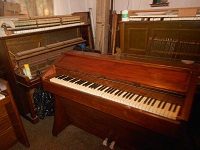
If it’s good enough for Steinway, it’s good enough for Brian Lawson, whose kitchen has been given over to the reconstruction, restoration, and repair of pianos. In fact virtually the entire 7th Avenue house has been devoted to pianos since Brian moved in, in 1999. 

He built a second story to make room for life without pianos but even then, there is only one chair in front of his computer. This is not a house for socialising or relaxing. It is a workshop.
 
After he finished school in Essex in the UK in the 1970s Brian, who says he grew up on the Beatles and prefers rock to classical music, went on the dole. His father was a trained classical pianist who eventually became a piano teacher in the local area. He persuaded Brian to register for a three year course in Piano Tuning, Repairs, Construction and Design at the London College of Furniture.

After working in the UK for a few years, Brian emigrated to South Africa in 1983 on contract with Kahn's Pianos. He went on to work for local piano retailer and then for 'The Music Shop' before setting up on his own in the Bez Valley house, which was previously owned by a fridge mechanic who used the front room - now crammed with pianos - as a night school for fridge mechanics.

“It is a question of adeptness and patience as well as excitement and passion,” Brian says, demonstrating the intricate process of cutting and sticking identical strips of leather eighty-eight times for the eighty-eight keys of an average piano.

Mice cause the most damage so five well-fed cats play an integral role in the life of the workshop.

Piano design has been dictated by fashion over the years, Brian says, pointing to an art deco piano.  “A modern family in the 1930s and 1940s needed a small piano”.
Pianos today are even more streamlined and mostly imported from 12 or more Chinese manufacturers.

A piano's value hinges on the quality of the sound it makes rather than its antiquity, Brian stresses, comparing a piano made in the 1890’s to a more recent Broadwood.

Generally pianos are tuned once a year but pianos in recording studios are tuned every day and concert pianos after rehearsals and again an hour or so before  a performance.

One of about 15 piano tuners in Gauteng, Brian leaves the more stressful work to others unless called upon to fill in when they are away, and avoids pressurised work if he can. "Why should I make somebody else's bad planning my emergency?" he says.

 www.lawsonic.co.za

Tuesday, 30 August 2011

Mrs Jeenah

It was comforting though not always comfortable when Mr. and Mrs. Jeenah lived opposite.  They were elderly and always there.  Mrs. Jeenah, a tiny woman with a scrunched up face and beak like nose, would sit on a wicker chair on the verandah and keep tabs. She was a busybody who knew everything about everyone. Although this could be unnerving at times, it was also consoling to know that somebody was keeping an eye on the comings and goings in Eighth Avenue. 

Before dementia made her frighteningly paranoid and she would summon me into her house to inspect an imaginery hole in the ceiling where imaginery burglars had forced entry and stolen her imaginery possessions, she would go through phases of being pleasant and unpleasant. It was as though she would make a conscious effort to be a good neighbour and after a few weeks of this, another persona would take over and she would become spiteful and mean.
At Christmas one year when she was in a good neighbour phase, she sent Phumzile across the road with a large box of chocolates and a card.  The card was not a Christmas card but a wedding card, and a very kitsch one at that, of an exaggeratedly perfect bride and groom standing arm in arm outside a church, with multi-coloured glittery confetti being showered upon them.

I never worked out what that card was really saying. I thought about it for quite a while.  Was it that Mrs. Jeenah had absolutely no idea what Christmas was about, or was a handsome groom at a perfect wedding her Christmas wish for me, or was her sinister persona emerging and was she insinuating that I was somehow lacking because there was no man in the house?  Because she was not a straightforward person, even now it is impossible to say.

When the Jeenahs sold their house and the West African community moved in, I missed Mrs. Jeenah. I think of her often still.

*Real names have not been used.  

Wednesday, 24 August 2011

Justice

“Every day I do something… I am just trying to maintain…”

Justice Thoka pays R550 a month for a small room in a house in 7th Avenue, Bez Valley, where he lives with his wife and two children.  The house belongs to a Nigerian who apparently owns several properties in the area.  Justice hasn’t had any permanent work since he came to Jo’burg City as a 20-year old matriculant seven years ago.  Apart from a few contract jobs with  ‘Real Landscape’ and as a security guard, he has had to find creative ways to sustain himself from day to day. 

Every morning he reports for work at the local Pikitup dump at 8h00 and leaves when the dump closes. He has been doing this for 18 months. He is a volunteer but is hoping that Pikitup will eventually employ him.
He survives by fixing and reselling whatever he can salvage, and from tips for helping people to offload waste.

In quiet times, when every bit of redeemable waste has been retrieved and rehabilitated, Justice cultivates a small garden made from broken ornaments, discarded pots and bits of bric-a-brac that can’t be fixed. In between these bits and pieces of junk, he grows vegetables and flowers that he has found around Bez Valley and replanted.   “We eat this every day,’ he says, pointing to spinach growing in pots and patches of soil on the concrete.  "In November I will plant tomatoes and potatoes." 
Justice learned vegetable gardening from his grandmother, who still grows vegetables at the family home in Rustenburg.

Monday, 15 August 2011

Katy Mazibuko

“I am just doing it. It's on my head. Nobody taught me. I love plants very much.”

Katy Mazibuko is a networker and a gardener.  Years ago she planted a tiny lemon tree in front of my house. Today it towers over my property and provides an abundant supply of lemons.
Katy is constantly on the lookout for a patch of ground to plant a flower or a shrub, or for an unused piece of concrete to plant a tree in a pot.

Her networking skills give her inside insight into life behind closed doors in Eighth Avenue. Once I asked her if she knew of anyone who could sew. Pointing to the house across the road she said, “First there is the Niger, then the Indian, then the Zimbabwe, then the China, then the China with the wife. That wife, she sews.”  I counted off 199 for the Nigerian, 197 for the Indian, 195 for the Zimbabwean, 193 for the Chinese and 191 for the Chinese man with the wife and sure enough, the wife did sew and I paid her to alter my lounge curtains.

Katy lives in one of four backrooms on a property in Eighth Avenue. She has been there since 1998. In the past the tenants were constantly changing because of the ill temper of the owner of the house. These days there is a difference. “I told him he will get criminals here if he is never satisfied. I said, there are no angels in this world”.
Katy has collected flowers and plants since she was a child. Growing up in Newcastle, she would bring them home and put them in glass bottles in the house. 

In 1965, when Katy was 13, her mother, a domestic worker in Bezuidenhout Street, Yeoville, brought Katy to Johannesburg to look after her baby sister.  When she was 17, Katy began work as a domestic worker herself. Gradually she accumulated piece jobs in Yeoville, Kensington and Bedfordview.

“I started to like plants more when I was working in Bedfordview,” she says. “I had a lot of plants and I sent them home. When I went home to Newcastle on leave I planted a big avocado tree.  Everyone knows that avocado tree. Then from there I carried on and carried on and carried on…  When I retire I want to plant and sell. I am growing vegetables where I work in Bedfordview. They have given me a big space there and I have planted potatoes, tomatoes, spinach… everything”.
In the backyard of the house where she lives, Katy has her own garden. In a small contained area outside her room she grows an assortment of plants as well as lemon, guava, orange, mango, and avocado and banana trees - all in pots. I asked her where she found the plastic fence for her garden. “I don’t remember. I just picked this thing up somewhere”, she says. “It protects my plants".

Tuesday, 26 July 2011

Neighbours

Properties here are small and close together. There is a mingling of sounds and smells and emotional  states. It is inevitable. I know when one of my neighbours is ill before I get told. I know when things are going well and not so well.
Rikkia, my neighbour to the right, shares her scrumptious meals generously. I don’t have to wait for Eid to receive gifts of curry and roti and homemade cookies and other delights through the gap in the blade wire fence dividing her property from mine.  Even during Ramadan she calls me to the fence: "Here are some feta pies I know you like so much..." I share too, though not as generously. In my wildest dreams I wouldn't be able to cook the way Rikkia does.   

Rikkia likes flowers – pink flowers of any variety. I buy her a bunch of pink flowers from time to time.

At Easter I give the children Easter eggs and at Christmas, sweets and cake.  When my neighbours celebrate Eid, such a stream of treats is passed through the fence it is almost overwhelming.

Through this sharing we understand one another’s traditions and habits and preferences and also our struggles and the sadnesses of our lives. According to Rikkia, God has a minute by minute interest in what is happening to us too. “The Almighty knows everything about you and me, Melody…” she says with confidence.

Thursday, 14 July 2011

Poverty in Bez Valley

On an average Friday, the day that the Pikitup truck collects, the sound of hawkers and vendors pushing their carts or stolen supermarket trolleys full of bits and pieces to the local dump for whatever few cents they can get for waste starts in the early hours of the  morning.
There are different sounds depending on the vehicles used; which supermarket the trolleys originate from perhaps; or the nature of the goods: The clunk-clunk-clunk of metal waste; the high-pitched clinking sound of glass bottles; and the thud of a mixed bag of goods. The visuals of the trolleys, and their owners, demand their own, separate exploration.
I am not attuned to the nuances of these sounds. I am trying to listen to them in a new way. I am inclined to lump them together under the umbrella of poverty and desolation.

The noises made by the trolleys or carts or makeshift conveyors of goods are usually - almost always - accompanied by the sound of coughing and spitting. I don’t actually hear the phlegm splattering onto the pavement but I imagine it. I have become over-sensitive to spitting after I saw some bloodstained phlegm on the pavement.

It lay in a strange shape like the Tarot card for sorrow in some packs, or a child's sticker of a broken heart, or the shattered skull of a misguided bird that has flown into glass thinking it is sky.

Thursday, 23 June 2011

Apostolic Faith Mission Church

Before the Apostolic Faith Mission became the Apostolic Faith Mission Impact Church, the caretaker of the property was a man called Elias, a Zimbabwean with a dark complexion and a dark demeanor. His wife, Dorothy, appeared at my gate one day. She said she was a “good Christian woman” looking for domestic work. I took her on. 
Her Christian fervor spilled over into her work. She would pray in tongues over the ironing, sometimes weeping copiously.
Over time she began to speak to me about the difficulties of being a Zimbabwean in South Africa. She had several sons who were constantly making their way over the border and then being deported, only to return again a few weeks later. 
Her marriage to Elias was an ongoing trial.   The couple slept in the sacristy of the church (the small room leading off the main place of worship in a Christian church in which sacred objects such as vessels and vestments are kept) and often in the middle of the night, Dorothy would be banished to the cold dark pews of the church for the night. The light switch was in the sacristy and Elias would guard it and refuse to switch it on, forcing the poor woman to fumble around in the dark in the church.
He was particularly violent and abusive when Dorothy prayed in tongues during the night, or when she was menstruating. 
After a night of sleeping on a wooden pew in the church (especially in winter), Dorothy would arrive for work with swollen eyes and a body heavy with grief and lack of sleep.
But as with so many abusive relationships, when she and Elias were getting on well, Dorothy’s face would glow with joy and fulfillment. All the ups in her marriage to Elias were attributed to Jesus and all the downs to Satan and although she would mutter her contempt for her husband from time to time, she did not want anyone to side with her and say anything bad about the wretched man.
One Saturday afternoon I went looking for Dorothy at the church. I had mislaid something I needed and thought she might know where it was. I found her in the kitchen leading off the church hall, preparing a huge meal for family members visiting from Zimbabwe.  She was evidently not pleased to see me and with a grim expression made a clutching and wrenching gesture towards her neck and the sides of her head. It took me a few minutes to realize that she was wearing the only valuable necklace and earrings I possessed.
After a distressing weekend thinking how I would deal with the issue of the missing jewelry, I waited for Dorothy to arrive for work on Monday, imagining that she would explain why she had borrowed the necklace and earrings and return them, and everything would return to normal. But she never came back to work.
Elias said she had gone back to Zimbabwe but I see her in the streets of Bez Valley or at Darras Centre from time to time.  Once, she waved.
*Not their real names.