The parallel consciousness of self and surroundings... is the key to transforming mentalities and reshaping societies.” -

Edouard Glisant


Friday, 9 September 2011

The Piano Tuner

Founder of the famous piano company, Steinway & Sons, Henry E. Steinway (1797-1871) began his career in the kitchen of his house in the town of Seeson in Germany. In 1836 he built a grand piano that became known as the “kitchen piano”. Today it is on display in the New York Metropolitan Museum of Art.

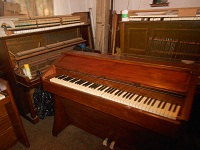
If it’s good enough for Steinway, it’s good enough for Brian Lawson, whose kitchen has been given over to the reconstruction, restoration, and repair of pianos. In fact virtually the entire 7th Avenue house has been devoted to pianos since Brian moved in, in 1999. 

He built a second story to make room for life without pianos but even then, there is only one chair in front of his computer. This is not a house for socialising or relaxing. It is a workshop.
 
After he finished school in Essex in the UK in the 1970s Brian, who says he grew up on the Beatles and prefers rock to classical music, went on the dole. His father was a trained classical pianist who eventually became a piano teacher in the local area. He persuaded Brian to register for a three year course in Piano Tuning, Repairs, Construction and Design at the London College of Furniture.

After working in the UK for a few years, Brian emigrated to South Africa in 1983 on contract with Kahn's Pianos. He went on to work for local piano retailer and then for 'The Music Shop' before setting up on his own in the Bez Valley house, which was previously owned by a fridge mechanic who used the front room - now crammed with pianos - as a night school for fridge mechanics.

“It is a question of adeptness and patience as well as excitement and passion,” Brian says, demonstrating the intricate process of cutting and sticking identical strips of leather eighty-eight times for the eighty-eight keys of an average piano.

Mice cause the most damage so five well-fed cats play an integral role in the life of the workshop.

Piano design has been dictated by fashion over the years, Brian says, pointing to an art deco piano.  “A modern family in the 1930s and 1940s needed a small piano”.
Pianos today are even more streamlined and mostly imported from 12 or more Chinese manufacturers.

A piano's value hinges on the quality of the sound it makes rather than its antiquity, Brian stresses, comparing a piano made in the 1890’s to a more recent Broadwood.

Generally pianos are tuned once a year but pianos in recording studios are tuned every day and concert pianos after rehearsals and again an hour or so before  a performance.

One of about 15 piano tuners in Gauteng, Brian leaves the more stressful work to others unless called upon to fill in when they are away, and avoids pressurised work if he can. "Why should I make somebody else's bad planning my emergency?" he says.

 www.lawsonic.co.za

Wednesday, 7 September 2011

More about dogs

Speaking on a panel with other poets and short story writers at an event to celebrate the shortest day of the year, Chris van Wyk, who grew up in the historically very poor area of Riverlea, said if people in his community wanted a dog, they went out into the streets and got one. There are many streetwise dogs, or 'brakke' as they are known, in Bez Valley and surrounding suburbs. There are also more and more feral dogs moving around in packs, scavenging for scraps in piles of waste on street corners or outside local shops. 

Occasionally more refined dogs can be seen roaming the streets, such as the emaciated giant black poodle that wanders up and down Stewart Drive. 

My dogs are too insignificant in stature to be valued in my neighbourhood; an elderly Maltese, known as Miss Daisy or Fluffy, and a bad- tempered, overweight Dachshund, Ansel, who is only loved by his mother (me).
Bucks is my next door neighbour's dog.  There is no garden next door (it was covered over with concrete, the favoured option in many Bez Valley properties) so he gets his exercise by hurling himself down the concrete corridor alongside the house. Occasionally he is let out onto the pavement when my neighbour comes home from work.  My neighbour says he doesn’t have the time to take Bucks for a walk in the park and anyway, being constrained makes Bucks vicious, which is useful. But he loves Bucks in his own way. When he calls out: “Bucksie boy!” there is affection and admiration in his voice.  “His father is a bulldog,” he says with pride. I am different from my neighbour. We don't really share the same understanding of what is most important in life, but we are concerned for one another's welfare. There is compassion and respect between us.
 
Two fox terriers, Ninja and Cheeky are greeted with territorial aggression from Bucks, Ansel and Miss Daisy when they take a daily walk past the gate at dusk.

There is a growing trend of young men with well developed biceps and tattoos, swaggering with ostentatious bravado down the streets of the 'hood' holding leads (or tenuous looking rope) attached to straining, salivating, pit-bull terriers with names like Zeus.  Their impact is significant; shrieking men, women and children disappear in seconds.
The SPCA gets 15-20 reports of cruelty to animals every day. The worst cases are from Chinatown.  "Animals are not treated in a decent way by Chinese people,” the woman from the SPCA told me. “We try and educate them before removing the dogs but mostly they pretend not to understand what you are telling them.  They pretend not to understand English.  We use sign language to show dogs must have a bigger space, a kennel, showing them what to do…but they don’t understand.”

Tuesday, 6 September 2011

A dog called Police

The family that bought the house from Mr. and Mrs. Jeenah moved in almost secretly. There was no furniture delivery truck, no van loaded with household goods. The first signs that the house was occupied by my new neighbours were curtains drawn closed at the windows and a howling, mangy dog running up and down the concrete yard from early morning until nightfall.  I tried ringing the bell at the gate and calling out from the pavement but nobody ever responded, though once or twice I would see the curtain pulled slightly to one side by a woman wearing the brightly coloured patterned fabric that West African women wear.

At night men would arrive in three shiny, new cars and two or three women, one carrying a child on her hip, would appear briefly from inside the house to welcome them. Their heads were covered and their bodies shrouded in the ankle length garments that Muslim women wear.

The metal, roll up gate on the side of the house would be lifted, the cars would drive in, and the gate would close behind them. 

Stock Image : German shepherdWithin weeks of moving in, truckloads of building supplies were delivered and construction work began in the back yard of the house. Then a huge satellite dish was installed on the roof. From my glimpses into life beyond the metal gate, I surmised that quite a number of people were living on the property, but the house was always cloaked in silence, like a ghost town.

At night when the men returned, the dog was locked out to roam the streets. At sunrise he would wait loyally at the gate to begin another miserable day of running up and down on the other side of the fence.  

I noticed the dog had an infection around his eyes, which were inflamed and bleeding. Increasingly distressed, I finally confronted one of the men. His name was Moosa.  He agreed to take the dog to the vet. When there was no sign of this, I reported my neighbours to the SPCA.

These days the SPCA’s strategy is to rehabilitate the owners of pets rather than remove the animals. In this case, my neighbours were instructed to take the animal to the vet for inoculation and treatment. When I complained that the dog was still running up and down a small stretch of concrete, still howling, and still being locked out at night, the man I spoke to from the SPCA said he could not intervene because the owner of the dog had complied.

Again I confronted my neighbour. I asked him if he would like to find another home for the dog, whose name, I established, was ‘Police’.  He said, “You can take the dog but first you must give me another dog. And I want a big dog, not small dogs like yours…”

I befriended the dog. I bought a box of biscuits for large dogs and fed him through the fence. After a while, he allowed me to stroke his mangy head, then he began to wag his tail when I came out my front door, and to lick my hand when I approached him.  A couple of times in the days and weeks of my relationship with Police, I saw the curtain stir at the window and realised I was being watched. Once, one of the men came out of the metal gate when I was feeding the dog, and demanded to know what I was doing.

I spoke to the local vet about the situation. “It’s tricky”, he said. 

Early one morning, I saw Police waiting outside the gate on the pavement as usual, then I heard the men drive off.

Later in the day I noticed that the dog was not there.  He was not there the next day either.  Finally on the third day, I confronted Moosa.  “Where’s Police?” I asked.  “He ran away,” he responded with a  sullen expression, turning away. We have not spoken since.

There is a new dog, also an alsation, a puppy, kept behind the metal gate. I catch a glimpse when the men leave or arrive.

Wednesday, 31 August 2011

Survival and the city

Just over the Bez Valley border, in a street lined with gum and oak trees, rich with birdlife, women congregate in pairs or small groups on the pavement outside large Observatory properties.  They are aged between 18 and 40 and come from South Africa, Zimbabwe, Mozambique, Angola, the DRC, Malawi and Zambia. They live in Observatory, Yeoville, Bellevue East, Bez Valley, Bertrams, Kensington, Orange Grove and Vorna Valley.   

There is a loose affiliation between the women, and a pecking order. South African women get first preference for rooms in a guest house on Louis Botha Avenue, which are rented out at R50 an hour or R30 for half an hour. Clients are “Whites, Indians, Nigerians, all kinds…We don’t know them, we don’t ask questions unless they say they want to spend some life with you or if they propose you. That’s when they will tell you about their history.  Then they will tell you, I come from India, or from London, or from Australia.  Others lie to us.”
The younger women insist on condoms; the older women are more willing to compromise if they are paid enough. Fees range from R100 to R600.  

Younger sex workers are expected to pay compensation - often at knifepoint - if an older woman loses a regular client because of them. Sometimes they are forced to give up all their earnings.
Sibongile is Zimbabwean. Her mother lives in Zimbabwe and her father lives in Johannesburg. Since he married a South African woman, her father has failed to support her. She lives with her stepsisters who don’t know what she does. “They think I am chilling and working at Bruma for those Chinese shops.” She works on Mondays, Tuesdays and Wednesdays and generally has about four clients a day.  

Evidence, also a Zimbabwean, is 18.  She came to South Africa two years ago on her own. Both her parents are dead and she has no family.  “This thing is a risk. I am doing it because of my situation.  Otherwise I must sleep in the streets.”

*Not their real names.

Tuesday, 30 August 2011

Mrs Jeenah

It was comforting though not always comfortable when Mr. and Mrs. Jeenah lived opposite.  They were elderly and always there.  Mrs. Jeenah, a tiny woman with a scrunched up face and beak like nose, would sit on a wicker chair on the verandah and keep tabs. She was a busybody who knew everything about everyone. Although this could be unnerving at times, it was also consoling to know that somebody was keeping an eye on the comings and goings in Eighth Avenue. 

Before dementia made her frighteningly paranoid and she would summon me into her house to inspect an imaginery hole in the ceiling where imaginery burglars had forced entry and stolen her imaginery possessions, she would go through phases of being pleasant and unpleasant. It was as though she would make a conscious effort to be a good neighbour and after a few weeks of this, another persona would take over and she would become spiteful and mean.
At Christmas one year when she was in a good neighbour phase, she sent Phumzile across the road with a large box of chocolates and a card.  The card was not a Christmas card but a wedding card, and a very kitsch one at that, of an exaggeratedly perfect bride and groom standing arm in arm outside a church, with multi-coloured glittery confetti being showered upon them.

I never worked out what that card was really saying. I thought about it for quite a while.  Was it that Mrs. Jeenah had absolutely no idea what Christmas was about, or was a handsome groom at a perfect wedding her Christmas wish for me, or was her sinister persona emerging and was she insinuating that I was somehow lacking because there was no man in the house?  Because she was not a straightforward person, even now it is impossible to say.

When the Jeenahs sold their house and the West African community moved in, I missed Mrs. Jeenah. I think of her often still.

*Real names have not been used.  

Wednesday, 24 August 2011

Jo'burg's 'Bridge of San Luis Rey'

The winding road that connects the valley with the top of the ridge is Johannesburg’s ‘Bridge of San Luis Rey’ 


The road was named after Joseph Stewart, a socially concerned and active man who devoted himself to the community for 25 years. The beautiful arched walls, built of stone from the koppie, still exist.  Once there was a plaque marking the outcrop of the ‘Brixton Qaurtzite’ which forms the Observatory Ridge, but it was apparently shot to smithereens by vandals in a passing car during the apartheid era at about the time when David Webster was assassinated.

One story of the origins of Stewart Drive is that it was built by Italian prisoners of war (the 1939-1945 War); another is that it was part of the city engineer’s work programme for the unemployed during the Depression and was completed in 1935.

The road winds its serpentine way through dense gum-tree forests, though the protecting fence has long been dismantled and sold - ‘shipped to China’ as they say at the all-accepting, turn-a-blind-eye scrap dealers in the valley. This is the final destination of almost all the man-hole covers and fence-posts in the district.  Another fence, only partially stolen is the more recent initiative of a local politician. It separates the park at the top of the road from the ‘jungle’ below.
Benches for weary travellers, thoughtfully constructed by the road’s builders at key points on the steep path, have also been stolen. Only one or two concrete legs remain.

Once there was a pedestrian route up the ridge, coming out at the corner of Beatty and Hill streets, but the story goes that long ago, an ‘Italian megalomaniac developer’ filled it in with rubble from the demolished white elephant ,’Von Brandis Garage’ in Jo’burg City, thereby blocking the watercourse and precipitating his bankruptcy (so it is said). Such paths in the city (like the path up Houghton ridge) have, in any event long become too dangerous for walking.
‘Robber-barons’  come down a well-trod path at a lonely dark bend in the forest, from wherever they dwell with impunity (from all accounts), when they see travellers wending their way fearfully upwards. Sometimes, it is said, they place rocks in the road, late at night, to puncture the tyres of cars of unsuspecting travellers.

It’s a quarter of a kilometre of utter lawlessness, a real fairy tale world of bandit kings, a piece of Johannesburg that exists apart. Anyone who takes the time to offer a lift to people waiting fearfully at the top or at the bottom of Stewart Drive will meet all the characters of a modern fairy-tale: Beautiful young maidens; goodly parents shepherding small children to and from the crèche at the bottom of the hill; wise old folk; children like ‘Little Red Riding Hood’ on an errand; two angels from the Celestial Church of Jesus Christ, and a band of pilgrims almost robbed by two leather-jacketed men with guns.
I have met a Franco-African maths teacher on his way to and from a part-time post at the High School  below the imposing stone abandoned Sir Herbert Baker built Observatory , and a tutoring job in the valley; a Congolese former diplomat, Japanese and Spanish-speaking, hoping to go to London; a French teacher; a schoolboy who left his  ragged school blazer in my car (still hanging hopefully in my cupboard); an artisan who lives in a house of safety for people with mental instability; and a young business and family man, on his way to a Hillbrow pharmacy to buy 'family planning items'.

'Don’t stop to give people a lift any more, and keep your doors locked. You may be hijacked!' a local politician, cautioned. 'You can’t trust anybody these days'

Justice

Every day I do something… I am just trying to maintain…”

Justice Thoka pays R550 a month for a small room in a house in 7th Avenue, Bez Valley, where he lives with his wife and two children.  The house belongs to a Nigerian who apparently owns several properties in the area.  Justice hasn’t had any permanent work since he came to Jo’burg City as a 20-year old matriculant seven years ago.  Apart from a few contract jobs with  ‘Real Landscape’ and as a security guard, he has had to find creative ways to sustain himself from day to day. 

Every morning he reports for work at the local Pikitup dump at 8h00 and leaves when the dump closes. He has been doing this for 18 months. He is a volunteer but is hoping that Pikitup will eventually employ him.
He survives by fixing and reselling whatever he can salvage, and from tips for helping people to offload waste.

In quiet times, when every bit of redeemable waste has been retrieved and rehabilitated, Justice cultivates a small garden made from broken ornaments, discarded pots and bits of bric-a-brac that can’t be fixed. In between these bits and pieces of junk, he grows vegetables and flowers that he has found around Bez Valley and replanted.   “We eat this every day,’ he says, pointing to spinach growing in pots and patches of soil on the concrete.  "In November I will plant tomatoes and potatoes." 
Justice learned vegetable gardening from his grandmother, who still grows vegetables at the family home in Rustenburg.

Sunday, 21 August 2011

"Jesus went out to a mountainside to pray..."

On Stewart Drive a group of women with children signal that they want a lift up the hill but I am running late so I don’t stop.  At any hour of the day there are people waiting for a lift up or down Stewart Drive, which has become fraught with crime. Cell phones and cash are stolen at gunpoint by thugs who emerge from the bush and are apparently immune to police intervention.  Women have been raped.

Richard and I begin our ascent up Observatory Ridge from Gascoyne Street, navigating the uneven, rocky terrain towards the Anglo-Boer War Indian Troops Memorial. It is difficult to imagine that in the late 1800s and early 1900s, the ground was relatively even and a journey on horseback from Yeoville to Germiston would take approximately 40 minutes.  Year upon year of soil erosion has fostered the rocky surface of the ridge as it is now.
Litter; burnt stubbly grass; human excrement; the occasional discarded shoe or forgotten item of clothing; and remnants of animal sacrifice are part of the geography.

Several members of African Independent Churches, doing the best they can in an urban setting to follow Jesus’s example of going up into the mountain to pray, are dotted across the landscape.  One man is wailing and pounding the earth with his fists; a group of women and children led by a young priest are holding a prayer meeting; and two men pray loudly over a crying child.  They  are from the ‘Church of the Apostolic Faith of Jesus Christ’ and the ‘Limpopo Rock Church’.  Further along the path, a solitary hermit, dressed in yellow, is staring out over the valley a short distance from a rough shelter he has constructed by draping shreds of fabric over a couple of rocks.
Only a few protea trees remain on the ridge. Once there were many but they have been chopped down and used for firewood.

Small yellow and white veld flowers scattered spasmodically along the path, announce the beginning of spring.
Richard points out the remains of the rock circles that mark the activity of early iron smeltering dating back to approximately 1830.

The monument was erected towards the end of 1902 in honour of Hindu, Sikh, Christian, Muslim and Zoroastrian Indian members of the British Army who lost their lives in the Anglo Boer War. ‘Zoroastrian’ has been misspelt.  Originally the inscription was in Urdu, Hindi and English but only the English inscription remains.  It reads:

TO THE MEMORY OF BRITISH OFFICERS

NATIVES

NCO’S AND MEN

VETERINARY ASSISTANTS

NALBANDS

AND FOLLOWERS OF THE INDIAN ARMY

WHO DIED IN SOUTH AFRICA 1899 -1902

We squat uncomfortably amidst the flotsam and jestsam of separatist church ritual. I take Ivan Vladislavic’s novel, ‘Double Negative’ out of my bag and read a description of the valley:

“Stunned by the sunlight, we slumped against the rock with our faces turned to the sky, while Auerbach spoke about the history of the valley and the people who lived there as it passed from gentility to squalor and back again. You could still see some of the grand mansions on the opposite slope. Down in the dip there were houses that went back to the beginnings of the city that had survived the cycles of slum clearance and gentrification and renewed decline.

‘You think it would simplify things, looking down from up here…  but it has the opposite effect on me. If I try to imagine the lives going on in all these houses, the domestic dramas, the family sagas, it seems impossibly complicated. How could you ever do justice to something so rich in detail? You couldn’t do it in a novel, let alone a photograph…’”

‘Stunned by the sunlight’ like Vladislavic’s characters, Richard and I agree the description of the valley from the Kensington point of view applies as well to the vista from the Observatory side of the valley.

Driving back to Bez Valley down Stewart Drive, I give a lift to a young woman from the DRC with a baby on her back. She doesn’t  speak any English and I am too preoccupied to conjure up my school French.  We abandon ourselves to silence.